
Note: This article is for educational and informational purposes only. Any studies referenced relate solely to laboratory and scientific models. Peptides discussed here are for Research Use Only. They are not approved drugs, supplements, or cosmetic products and are not for human or veterinary use.
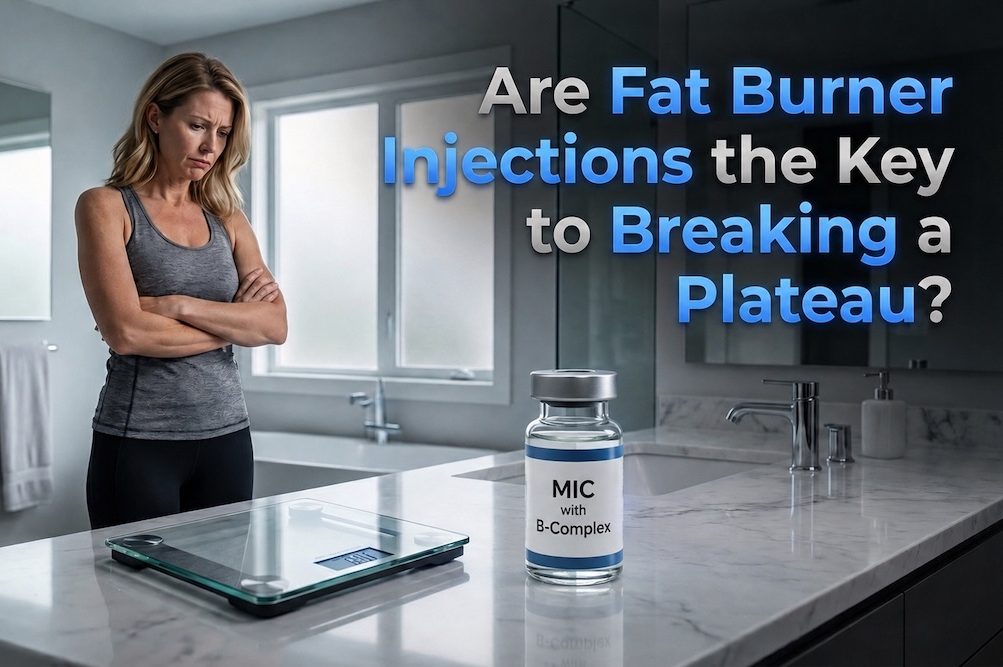
Most weight loss journeys begin with momentum. You improve your nutrition, increase your activity, and the scale responds. Then progress slows or stops entirely.
What makes a weight loss plateau so frustrating is that it often happens even when you are still doing everything right. Calories are controlled. Workouts are consistent. Discipline is intact. Yet body fat refuses to move.
In many cases, the issue is not effort. It is metabolic efficiency.
When fat loss stalls despite consistency, the next step is often improving how efficiently the body processes and utilizes stored fat.
Fat burner injections have grown in popularity because they focus on supporting how the body converts stored fat into usable energy at the cellular level. Rather than forcing temporary stimulation, nutrient-based blends aim to enhance the biological systems responsible for fat transport, liver processing, and mitochondrial energy production.
Why weight loss plateaus happen
As you lose weight, your body adapts. Metabolic rate can gradually decline, hormonal signals shift, and the system becomes more energy efficient. While this adaptation is normal, it can make continued fat loss more challenging.
Sustainable fat loss depends on several coordinated processes working smoothly:
- Stored fat must be mobilized from adipose tissue
- Fatty acids must be transported into cells
- They must enter the mitochondria to be converted into energy
- The liver must efficiently process lipids
- Energy levels must remain high enough to sustain activity and training
If any part of that chain becomes less efficient, progress can stall even when diet and exercise remain consistent.
The science behind modern fat burner injection blends
Many leading fat burner injection blends are built around amino acids and B-vitamins that play direct roles in metabolic pathways. They are often combined with GLP-1, GLP-2, and GLP-3 medications. See also “What is the Difference Between GLP-1, GLP-2. and GLP-3?”
Common ingredients include:
- L-Carnitine
- L-Arginine
- Methionine
- Inositol
- Choline
- Vitamin B5
- Vitamin B6
- Vitamin B12
Each supports a specific step in the process of converting stored fat into usable energy.
The goal is not to stimulate the metabolism artificially. The goal is to improve metabolic efficiency so your existing effort produces better output.
L-Carnitine and mitochondrial fat transport
L-Carnitine plays a central role in fatty acid oxidation. Long chain fatty acids cannot enter the mitochondria on their own. Carnitine acts as the transport mechanism that moves those fatty acids into the cellular engine where they can be converted into ATP.
Research has shown that L-Carnitine supplementation is associated with modest reductions in body weight and fat mass in certain populations, particularly when paired with lifestyle changes.
Supporting fat transport into mitochondria may help improve fat utilization, especially when fat loss slows during a plateau.
L-Arginine and circulation support
L-Arginine is a precursor to nitric oxide, which supports vasodilation and healthy blood flow. Improved circulation enhances oxygen and nutrient delivery to working muscles.
While not a direct fat loss driver on its own, improved performance capacity can support:
- Better workout intensity
- Improved endurance
- Higher overall calorie expenditure
- Greater consistency during structured programs
Consistency is often the key to pushing past a plateau.
MIC lipotropic nutrients and liver fat processing
Methionine, Inositol, and Choline are often referred to as lipotropic nutrients because of their involvement in lipid metabolism, particularly within the liver.
These nutrients support:
- Normal liver fat processing
- Lipid transport pathways
- Methylation processes tied to metabolic chemistry
- Cellular signaling related to nutrient balance
Optimizing liver-based fat processing may improve how the body handles both dietary fat and mobilized stored fat during calorie restriction.
B vitamins and metabolic energy
Fat loss requires energy. When calories are reduced, fatigue often increases. That fatigue can reduce daily movement and training intensity.
Vitamin B5 supports pathways involved in fatty acid oxidation. Vitamin B6 contributes to macronutrient metabolism. Vitamin B12 supports red blood cell production and cellular energy processes.
Energy drives adherence. Adherence drives fat loss.
Supporting energy conversion pathways can help maintain the consistency required to move past a plateau.
What makes this approach different from stimulant fat burners
Many over the counter fat burners rely on caffeine or similar compounds to temporarily elevate thermogenesis. While this may increase alertness, it does not necessarily improve fat transport or mitochondrial energy production.
Nutrient-based fat burner injection blends focus on supporting:
- Fat transport into mitochondria
- Liver-based lipid processing
- Cellular energy conversion
- Metabolic efficiency during calorie restriction
This makes them fundamentally different from stimulant-based products.
Who this can be a fit for
- Individuals who are stuck in a weight loss plateau despite consistent effort
- People already following a structured nutrition plan
- Individuals training regularly but experiencing low energy
- Those seeking non stimulant metabolic support strategies
These blends are best viewed as part of a comprehensive fat loss strategy rather than a replacement for foundational habits.
Breaking the plateau starts with metabolic efficiency
When progress slows, the answer is not always to reduce calories further or add excessive cardio. In some cases, improving how efficiently the body transports and converts fat into usable energy can be the missing piece.
Fat burner injection blends built around amino acids and B vitamins are designed to support the biology of fat utilization, liver processing, and energy production. When those systems function more efficiently, your effort is more likely to translate into measurable results.
Shop wholesale peptides and MIC compounds at https://wholesalepeptides.us.
FAQs about fat burner compounds and weight loss plateaus
Do fat burner compounds actually help with weight loss plateaus?
Are fat burner compounds the same as GLP 1 medications?
Do fat burner compounds burn fat without diet and exercise?
How fast do fat burner compounds work?

Related Posts:

BPC-157 and TB-500: Tendon and Muscle Research
BPC-157 and TB-500 are both studied for tendon, muscle, and soft-tissue repair, but they work through different biological pathways. This article compares the research, including a 2026 head-to-head Achilles tendon study.

Retatrutide vs Tirzepatide: Mechanisms, Clinical Trial Results, and Key Differences
Retatrutide (GLP-3) and tirzepatide (GLP-2) are two of the most discussed compounds in the modern weight loss conversation. While both are connected to the GLP-1 category, they do not work in exactly the same way.

Semaglutide vs Tirzepatide vs Retatrutide: Key Differences in 2026
This article compares semaglutide, tirzepatide, and retatrutide, including receptor targets, clinical trial results, FDA status, and key differences in 2026.

BPC-157 Safety and Human Research Guide for 2026
What are the most common retatrutide side effects? Recent clinical trials highlight primary gastrointestinal responses including nausea and digestive discomfort. Researchers have found that these effects are often dose-dependent, with specific escalation schedules significantly improving patient tolerability and long-term safety profiles.
